


Description
Application of Polyvinyl Acetate (PVAc) in Solubilization and Toughening Modification of PLA
Polyvinyl acetate (PVAc), as a solubilizing and toughening modifier for polylactic acid (PLA), has important applications in the field of biodegradable plastics. PVAc has good compatibility with PLA and can be uniformly dispersed in the PLA matrix to form a stable blend system. The molecular chain of PVAc contains ester groups, which have a similar molecular structure to PLA. There is a strong intermolecular force between the two, which can effectively improve the toughness of PLA.

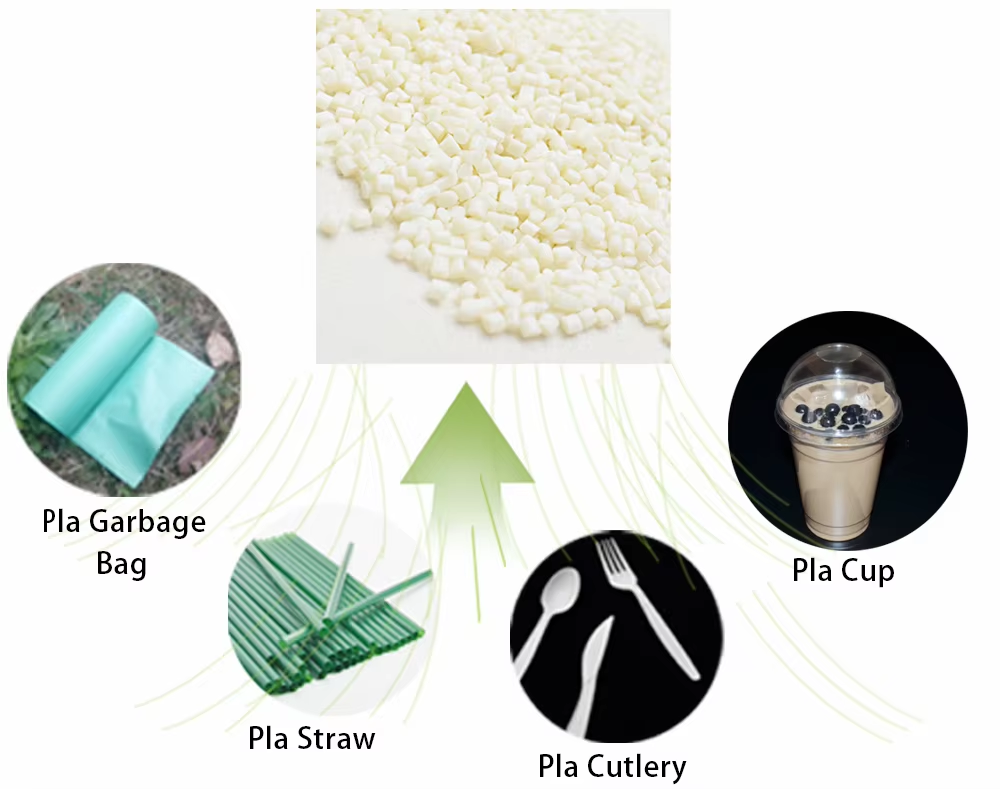
PLA is a biodegradable plastic derived from renewable resources such as corn starch, which has excellent mechanical properties and biocompatibility, but has disadvantages such as high brittleness and poor impact resistance. PVAc can effectively improve the toughness and processability of PLA while maintaining its biodegradability through blending modification with PLA.
________________________________________
📊 Main advantages
1. Good compatibility
PVAc has good compatibility with PLA and can be uniformly dispersed in the PLA matrix to form a stable blend system. The molecular chain of PVAc contains ester groups, which have a similar molecular structure to PLA. There is a strong intermolecular force between the two, which can effectively improve the toughness of PLA.
Research has shown that the addition of PVAc can promote the crystallization of PLA, increase its crystallinity and crystallization rate, thereby improving the mechanical and processing properties of PLA.
2. Significant toughening effect
PVAc has a low glass transition temperature (Tg of approximately 30-40 ℃) and can form a flexible phase in the PLA matrix, absorbing and dispersing impact energy, thereby significantly improving the impact resistance of PLA. When the amount of PVAc added is 10-20%, the impact strength of PLA can be increased by 2-5 times.
PVAc can also improve the fracture elongation of PLA, transforming it from a brittle material to a tough material and expanding its application range.
3. Biodegradability
PVAc itself has good biodegradability and can be decomposed into carbon dioxide and water by microorganisms in natural environments, without causing pollution to the environment. The blend of PVAc and PLA also has good biodegradability and can fully comply with the relevant standards for biodegradable plastics.
The addition of PVAc does not affect the biodegradation rate of PLA, but may instead promote its degradation, as the degradation products of PVAc can provide nutrients for microorganisms, accelerating their growth and reproduction.
4. Good processing performance
PVAc has good processing performance and can be blended with PLA on conventional plastic processing equipment (such as extruders, injection molding machines, etc.) to prepare products of various shapes and sizes. The addition of PVAc can reduce the melting temperature and viscosity of PLA, improve its flowability and formability, and reduce energy consumption and scrap rate during processing.
PVAc can also improve the thermal stability of PLA, increase its thermal deformation temperature and heat resistance, and expand its application range in high-temperature environments.
5. Cost advantage
PVAc has a relatively low production cost and a significant price advantage compared to PLA. The addition of PVAc can reduce the production cost of PLA products and improve their market competitiveness.
PVAc has a wide range of sources, mature production processes, and can be produced on a large scale to meet the market demand for PLA solubilization and toughening modifiers.
________________________________________
🔧 Instructions for use
1. Blending modification
Pre mix PVAc and PLA in a high-speed mixer at a certain ratio (usually 10-20% PVAc added), and then add the pre mixed material to the extruder for melt blending and extrusion to prepare PVAc/PLA blend.
The processing temperature of the extruder is usually 170-190 ℃, and the screw speed is 100-200rpm. The extruded blend can be prepared into particles through a pelletizing mechanism for subsequent processing such as injection molding, blow molding, and stretching.
2. Reactive blending modification
During the blending process of PVAc and PLA, an appropriate amount of reactive additives (such as maleic anhydride, diisopropylbenzene peroxide, etc.) can be added to form chemical bonds between PVAc and PLA through reactive blending, thereby improving the compatibility and interfacial bonding between the two and further enhancing the mechanical and processing properties of PLA.
The processing temperature for reactive blending is usually 180-200 ℃, and the screw speed is 150-250rpm. The blend after reactive blending has better mechanical properties and thermal stability, which can meet higher requirements for application scenarios.
3. Forming and processing
PVAc/PLA blends can be processed through injection molding, blow molding, stretching and other molding methods to produce various products, such as packaging materials, tableware, toys, medical supplies, etc. The temperature for injection molding is usually 170-190 ℃, and the mold temperature is 40-60 ℃; The temperature for blow molding is usually 160-180 ℃, with a stretch ratio of 2-4.
During the molding process, it is important to control the processing temperature and speed to avoid degradation and performance degradation of the blend. At the same time, appropriate post-processing (such as annealing, stretching, etc.) needs to be carried out on the product to improve its mechanical properties and dimensional stability.


Reviews
There are no reviews yet.